

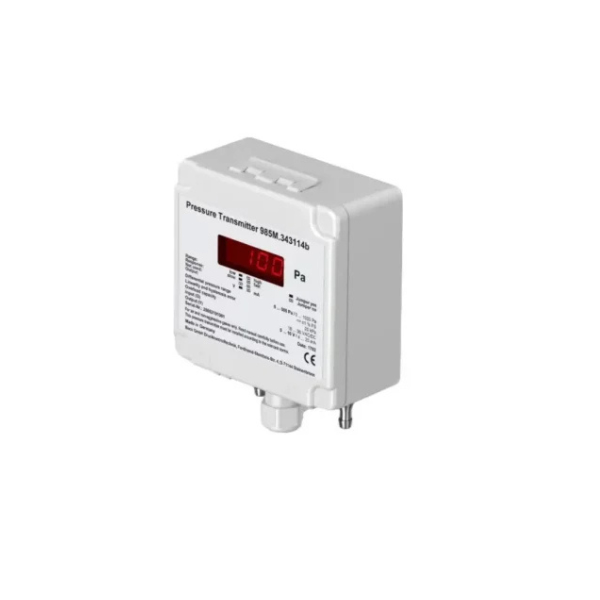
Understanding the Differential Pressure Transmitter 985
The Differential Pressure Transmitter 985 is a versatile instrument designed for accurate pressure measurements. It comes in 2-wire and 3-wire models, with manual or automatic offset calibration, respectively. The setting ranges vary depending on the type, from -100 Pa to 1 bar. The temperature range for the 2-wire model is -20°C to +70°C, while the 3-wire models operate from -10°C to +50°C. The process connection utilises a hose connection with 4/6 mm outer diameter for easy installation.
The transmitter requires a supply voltage of 18 to 30 VDC and offers an output signal of either 4-20 mA or 0-10 V, making it compatible with different systems. The electrical connection options include plug-in terminals for wires and strands up to 1.5 mm2 or circular connectors M12/4-pole. Additionally, with a protection class of IP65 according to EN 60529, the Differential Pressure Transmitter 985 ensures durability and resilience in challenging conditions.
Applications
The Differential Pressure Transmitter 985 is commonly used in building automation and air conditioning systems. In these settings, the transmitter measures the pressure difference between various points in the HVAC system. This information is essential for controlling fans, dampers, and other components to ensure efficient air distribution, maintain comfort, and optimize energy usage throughout the building.
In overpressure measurement in clean rooms and laboratories, the 985 transmitter plays a critical role in maintaining a controlled environment. By monitoring and ensuring that the pressure inside the clean room or laboratory remains higher than in adjacent spaces, the transmitter helps prevent the ingress of contaminants such as dust, microbes, or unfiltered air. This is vital for protecting sensitive processes, products, and personnel.
For the measurement of constant pressure in VAV applications, the Differential Pressure Transmitter 985 is used to maintain stable pressure in Variable Air Volume (VAV) systems. These systems adjust the amount of air delivered to different zones based on demand. The transmitter ensures that the pressure remains constant, allowing the VAV system to operate efficiently, improve occupant comfort, and reduce energy consumption, especially in large or complex buildings.
The 985 transmitter is also valuable for dynamic filter and ventilator monitoring. It continuously measures the pressure drop across filters and ventilators, providing early warning when a filter becomes clogged or a ventilator’s performance declines. This enables timely maintenance, helps prevent system failures, ensures consistent air quality, and extends the lifespan of ventilation equipment.


