

Subsea is where instrumentation earns its stripes. Crushing hydrostatic pressures, aggressive saltwater, biofouling, and service intervals measured in years rather than months mean that every sensor on the seabed has to be right the first time. Retrieval is expensive, ROV time is expensive, and unplanned downtime on a subsea asset is very expensive. Stork Solutions’ subsea range is engineered from the ground up for exactly this reality — permanent underwater deployment, minimal maintenance, and long-term measurement stability at depth.
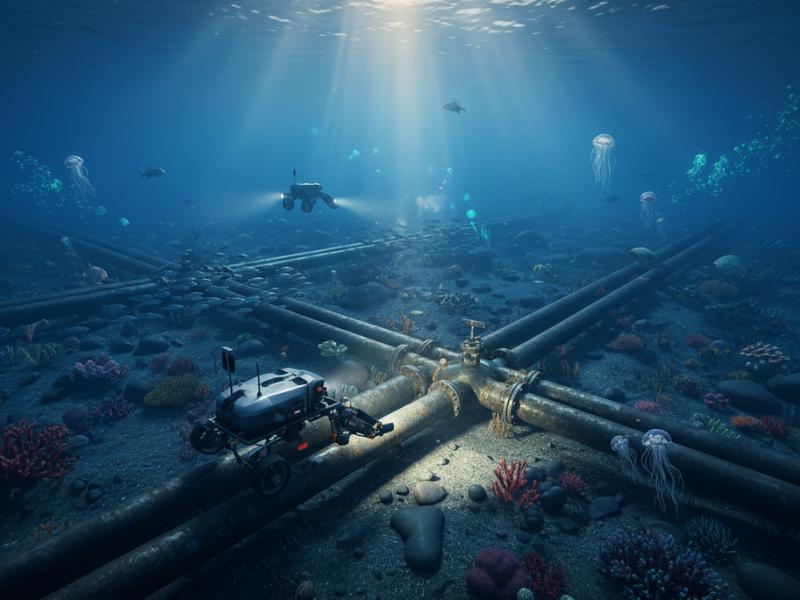
The Subsea Challenge
Before the hardware, it’s worth being honest about what subsea instrumentation actually has to survive:
- Hydrostatic pressure that scales linearly with depth — around 100 bar every 1,000 m.
- Saltwater corrosion and chloride attack on any weak point in the housing or connector.
- Biofouling that can smother sensor elements and change thermal response over time.
- ROV-only access — meaning connectors have to mate and de-mate underwater, and any failure costs a vessel day at minimum.
- Service lives are measured in years or decades, not months.
Everything in the Stork subsea range is designed around these constraints.
The Two Core Products
1. SSPT — Subsea Pressure Transmitter
The SSPT is Stork’s workhorse subsea pressure transmitter, purpose-built for deepwater and offshore applications where routine access simply isn’t possible.
Key highlights:
- Ceramic (96% Al₂O₃) piezo-resistive sensing element — inherently corrosion-resistant and long-term stable.
- Pressure ranges from 1 to 400 bar, covering shallow-water monitoring through to high-pressure deepwater hydraulics. Higher pressure ranges available.
- Accuracy of <0.25% FS as standard, with an optional upgrade to <0.10% FS for critical measurement points.
- Housing materials: Duplex stainless steel, marine bronze, or titanium — matched to the corrosive environment and project spec.
- Wet-mateable electrical connectors rated to 4,000 m depth, with customer-specified connector brands accommodated.
Typical roles: wellhead pressure, subsea hydraulic circuits, control pods, pipeline monitoring, and real-time ROV pilot feedback.
2. SSTT — Subsea Temperature Transmitter
The SSTT is the temperature counterpart — same design philosophy, same materials, same connector approach.
Key highlights:
- Class A PT100 sensing element — accuracy of <0.5 °C as standard, upgradable to <0.25 °C.
- Housing materials: Duplex stainless steel, marine bronze, or titanium.
- 2, 3 or 4-pin wet-mateable connectors rated for permanent submersion to 3,000 m.
- Optional protruding probe in various lengths for targeted measurement inside pipelines, manifolds, or process assemblies.
Typical roles: subsea pod and control module electronics protection, pipeline and manifold thermal monitoring, ROV environmental sensing, and long-duration research deployments.
Connectors and Materials — Where Subsea Sensors Live or Die
A subsea transmitter is only as reliable as its housing and connector. Two components that never fail on the datasheet, but do fail on the seabed.
Wet-mateable connectors:
- Can be mated and de-mated underwater — critical for ROV-led installation and maintenance without recovering the equipment.
- Rated to 4,000 m depth.
- Supplied to match customer-specified connector brands for seamless integration with existing umbilicals, junction boxes, and control systems.
Material options:
- Duplex stainless steel — excellent general corrosion resistance for most subsea applications.
- Marine bronze — strong chloride resistance and biofouling tolerance, ideal for long-immersion seawater installs.
- Titanium — the highest corrosion resistance and best strength-to-weight ratio; the go-to choice for deepwater and long-life critical deployments.
Being able to tune both connector and housing to the exact installation is what turns a good subsea sensor into a reliable one.
Where Stork Subsea Instruments Are Used
The SSPT and SSTT support a broad set of applications across multiple sectors:
- Subsea oil & gas monitoring — wellhead pressures, subsea hydraulic equipment, pipeline integrity.
- Underwater ROV instrumentation — environmental sensing, navigation support, equipment protection during IMR campaigns.
- Ocean research and data collection — long-duration oceanographic deployments where retrieval isn’t feasible.
- Offshore platform subsea monitoring — control pods, manifolds, umbilical terminations.
- Underwater pipeline monitoring — pressure and thermal profiling along critical export and infield lines.
- Deep-sea dredging — pressure on suction pipes and pumps to maintain efficient material transfer.
- Renewables and marine civil engineering — foundations, tidal, submerged infrastructure monitoring.
Beyond the Seabed — Marine and Topside Instrumentation
Subsea rarely sits on its own. Most projects also need pressure and level instrumentation topside, on the vessel or platform. Stork supplies a full range of marine-approved transmitters — including the DMK 457, DMK 458, and LMK 458 — carrying Lloyd’s Register, DNV, ABS and CCS certifications for use on ships, rigs, FPSOs and offshore platforms. That means a single supplier can cover the pressure and level story from the wellhead to the wheelhouse.
Browse the wider ranges here:
Specifying Subsea Instrumentation
Getting subsea instrumentation right is a balancing act between:
- Sensor performance (accuracy, range, stability)
- Material compatibility with the environment
- Connector specification and compatibility with the existing subsea architecture
- Depth rating
- Integration requirements with control pods, umbilicals and topside systems
Because the cost of failure is so high, most projects benefit from a technical conversation early — before the housing material or connector brand is locked in. Stork’s UK-based team works with subsea engineers, ROV operators, EPC contractors, and OEMs to specify the right SSPT and SSTT configuration end to end, from material and connector selection through to fully tested, project-specific delivery.
Final Thought
Subsea instrumentation isn’t about datasheet headlines — it’s about what still reads accurately five years into a deployment on the seabed. The Stork SSPT and SSTT are built around that reality: proven sensing technology, corrosion-resistant materials, wet-mateable connectors, and the flexibility to be tailored to each project.
If you’ve got a subsea application on the horizon — oil and gas, research, ROV, renewables, or marine infrastructure — talk to the Stork Solutions team early. It’s a lot cheaper to specify correctly than to recover and replace.
