

For vessel/headspace pressure measurement on a small EGSB anaerobic digester, a DMK 331 configured with 316L wetted parts and an FKM seal is, in most cases, a sensible default choice where the transmitter sees gas only and the pressure connection can be kept reasonably dry. The main engineering risk is not simply the presence of H2S in the gas phase, but whether the installation allows wet sour condensate to collect at the pressure port. If persistent condensate or liquid carryover is likely, the PVDF pressure port option becomes more attractive. Separately, because digester biogas contains methane, the final requirement for ATEX/UKEX/Ex approval depends on the confirmed hazardous area classification at the installation point.
Pressure instrumentation on anaerobic digestion systems is often specified as if the medium were just another low-pressure gas. In practice, raw biogas service is more complex. Even on a small EGSB digester, the transmitter may be exposed not only to methane and carbon dioxide, but also to hydrogen sulphide, water vapour and corrosive condensate.
This matters because the suitability of a pressure transmitter in biogas service is rarely determined by H2S concentration alone. A transmitter mounted on a clean, dry headspace connection may operate in a very different environment from one mounted where moisture repeatedly condenses into the pressure port. For that reason, a robust selection process has to consider materials, sealing, installation geometry and hazardous area classification together.
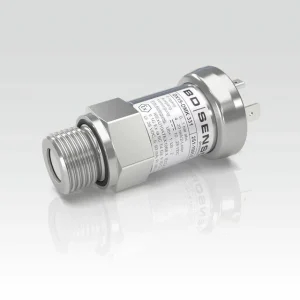
This article uses the DMK 331 as a practical example. The transmitter is available with material options including stainless steel 1.4404 / 316L, FKM sealing, and a PVDF pressure port option, making it a useful case study for this type of service. For applications involving viscous or pasty media with a flush-mounted diaphragm, the DMK 331 P variant may also be relevant.
The Application: Small EGSB Digester Vessel Pressure Measurement
The application considered here is measuring the vessel/headspace pressure of a small EGSB anaerobic digester. The process medium at the sensing point is expected to be raw biogas.
At first glance, this suggests a standard gas pressure transmitter should be suitable. However, there are three practical complications:
- raw biogas can contain variable levels of H2S
- the gas is commonly moisture-laden
- the final installation position may not yet be fixed, meaning the sensor could see anything from dry gas to persistent condensate
That uncertainty is important. A pressure transmitter on a dry, well-drained standpipe is one case. A transmitter mounted where condensate pools in the pressure connection is another.
What H2S Levels Might Be Seen in Digester Biogas?
Published data shows that H2S levels in anaerobic digester biogas are highly variable.
A BioCycle article reports that raw anaerobic digester biogas can contain H2S at levels ranging from 200 ppm to over 3,000 ppm. In the same source, field-scale dairy digester testing reported biogas H2S concentrations varying from 2,900 to 4,500 ppmv.
A separate industry source from MV Technologies states that H2S concentrations in biogas from anaerobic digesters can range from less than 100 ppmv to more than 20,000 ppmv, while also stressing that variability from site to site can be significant.
For a small EGSB digester, the exact value will depend on feedstock composition, sulfate loading, water chemistry, retention conditions and whether any H2S reduction method is used. In practical terms, the key conclusion is not the exact ppm figure, but that raw biogas H2S can easily reach the low-thousands of ppm and may vary substantially over time.
Why H2S Alone Does Not Decide the Material Selection
A common mistake in instrumentation selection is to treat all H2S-containing service as equivalent. In reality, there is a critical difference between:
- dry or mostly dry biogas
- wet biogas with condensed sour moisture
- liquid carryover or stagnant condensate sitting in the pressure port
This distinction matters because gas-phase H2S exposure is generally less aggressive than wet sour exposure, where H2S and CO2 can dissolve into condensate and create a far more corrosive micro-environment at the sensing connection.
In other words, the real question is not only “How much H2S is in the biogas?” but also “Will the transmitter connection stay dry?” For digester service, that often becomes the decisive engineering factor.
Assessing 316L and FKM for This Application
316L Wetted Parts
316L is the logical stainless choice for this application and is generally preferred over lower-grade stainless steels because of its better corrosion resistance. For headspace pressure measurement in raw biogas, 316L is usually acceptable where the instrument sees gas only and the pressure connection is not continuously wet.
In practical terms, 316L is a sound default where:
- the instrument is mounted on a gas tapping point rather than immersed in liquid
- condensate does not collect at the pressure port
- the installation avoids stagnant wet deposits
- the process does not introduce unusually aggressive contaminants beyond normal raw biogas exposure
FKM Seal
For this type of service, FKM is generally the preferred sealing choice. Compared with more general-purpose elastomers, it is usually the better fit where the service involves H2S-containing gas, hydrocarbon traces or uncertain gas composition.
For that reason, if the choice is between standard seal options for a biogas headspace application, FKM is typically the right starting point.
When the PVDF Pressure Port Should Be Considered
The PVDF pressure port is not automatically required simply because H2S is present in the gas. However, it becomes a strong option where the installation may expose the sensor to persistent condensate, acidic moisture, or liquid carryover. On the DMK 331, a G 1/2″ open-port PVDF pressure connection is offered specifically for use with aggressive media.
That means PVDF is worth considering when:
- the final installation position is unknown
- the pressure tapping is likely to run wet
- the instrument may be mounted where gas cools and condenses at the connection
- the sensor may be exposed to sour condensate rather than dry headspace gas
- previous experience on similar plants suggests corrosion at metal fittings or instrument ports
In short, PVDF is the more conservative option where condensate risk cannot be ruled out.
Installation Matters as Much as Material Choice
Even a good material selection can perform poorly if the installation encourages liquid collection at the sensing point. In biogas service, mechanical arrangement often matters as much as corrosion resistance data.
Good practice includes:
- mounting the transmitter so the pressure port remains as dry as possible
- avoiding low points where condensate can drain into the sensor
- using a standpipe, impulse line or arrangement that allows moisture to fall away from the transmitter
- considering traps or drainage points where condensation is unavoidable
- keeping the pressure connection simple and inspectable
This is especially relevant for a small digester installation where the final mounting position may be chosen for convenience rather than long-term instrument protection.
Hazardous Area Considerations: Is ATEX/UKEX Required?
For a biogas digester, the hazardous area question is driven mainly by methane, not H2S.
If the transmitter is installed in a classified hazardous area, an appropriately Ex-certified version is generally required. The DMK 331 is available as an intrinsically safe IS-version (Ex ia) for gases and dusts, alongside SIL 2 compliance to IEC 61508/IEC 61511. If it is remote-mounted in a demonstrably safe, non-classified location, that may not be necessary. The decision therefore depends on the site-specific hazardous area classification, not on a blanket rule.
For UK projects, this is typically considered under DSEAR/UKEX. In EU terminology, the equivalent discussion is generally framed as ATEX. In day-to-day engineering conversation, many teams still use “ATEX” generically.
The practical takeaway is simple: if the final installation point is on or near the digester, gas line, vent, condensate point or other potential release source, there is a good chance Ex approval will be needed. This should be confirmed before final order placement.
Practical Recommendation for the DMK 331 on This Application
Option 1: Standard Recommended Configuration
316L wetted parts + FKM seal
This is the preferred standard option where:
- the measurement is headspace gas pressure
- the transmitter sees gas only
- the installation can be arranged to keep the pressure port reasonably dry
- no persistent wet sour condensate is expected at the sensing point
Option 2: More Conservative Material Selection
PVDF pressure port + FKM seal
This should be considered where:
- the installation position is uncertain
- condensate at the pressure port is likely or unavoidable
- the connection may see liquid carryover
- the design cannot guarantee a dry sensing environment
Certification Requirement
ATEX/UKEX/Ex approval as required by area classification
This should be confirmed where:
- the transmitter will be installed in or near a classified biogas area
- the final location has not yet been confirmed
- site hazardous area classification has not yet been completed
Final Conclusion
For pressure measurement on a small EGSB anaerobic digester, the DMK 331 supplied by Stork Solutions is a credible option, but the correct configuration depends less on H2S presence in isolation and more on the actual service conditions at the sensing point.
If the transmitter is measuring dry or mostly dry headspace biogas, a 316L/FKM configuration is generally the sensible standard choice. If the final installation may expose the sensor to wet sour condensate, the PVDF pressure port option offers a more conservative corrosion-resistant solution. Separately, because biogas contains methane, the final need for ATEX/UKEX/Ex certification must be confirmed against the actual hazardous area classification of the installation location.
For engineers specifying instrumentation on digesters, the most important questions before ordering are therefore:
- What H2S range is expected, if known?
- Will the pressure connection stay dry?
- Could condensate pool in the sensor port?
- Where will the transmitter actually be mounted?
- Is that location within a classified hazardous area?
Answering those questions will do more to ensure long-term transmitter reliability than looking at H2S concentration alone.
