

Pressure measurement sounds simple on the surface. You install a sensor, take a reading and use the data. In practice, though, getting an accurate pressure reading depends on much more than just choosing any sensor that fits the connection.
The best way to measure pressure accurately depends on the application, the type of pressure being measured, the operating environment and the performance of the device itself. If the wrong sensor type, pressure range or installation method is used, the reading may be unstable, misleading or simply wrong.
In this guide, we look at how to measure pressure accurately, what affects measurement quality, and how to choose the right solution for different applications.
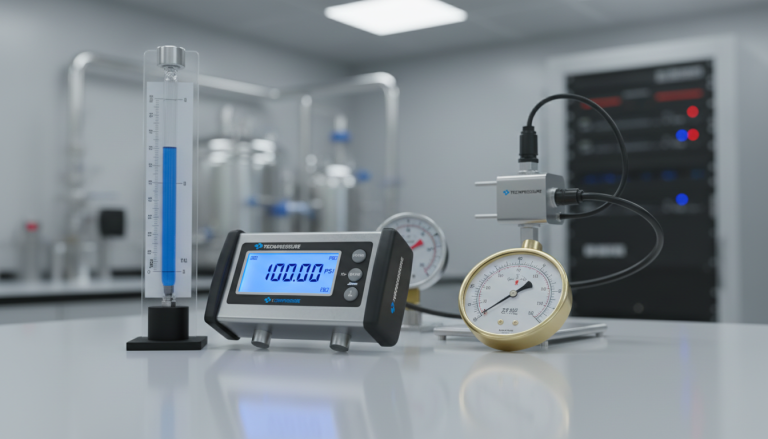
What does pressure measurement mean?
Pressure measurement is the process of determining the force exerted by a gas or liquid on a surface. In industrial systems, that pressure data helps operators monitor safety, control processes, protect equipment and maintain product quality.
Pressure measurement is used across a huge range of applications, including:
- process control
- hydraulic and pneumatic systems
- water and wastewater management
- leak testing
- filter monitoring
- tank level measurement
- weather and environmental monitoring
- subsea and offshore systems
Depending on the job, that measurement might be taken using pressure transmitters, pressure transducers, differential pressure transmitters, wireless pressure transmitters or pressure data loggers.
The best way to measure pressure accurately
The short answer is this: the best way to measure pressure accurately is to match the sensor and installation method to the application.
That means understanding:
- what type of pressure you need to measure
- the expected pressure range
- the media involved
- the environmental conditions
- the required output and communication method
- how the sensor will be installed
There is no single “best” pressure sensor for every use case. A solution that works well for atmospheric monitoring will not be the right choice for subsea deployment. A sensor that is ideal for leak testing may not be the best option for continuous remote monitoring.
Accurate pressure measurement always starts with correct selection.
The main types of pressure measurement
Before choosing a sensor, it is important to understand what kind of pressure you are actually trying to measure.
Gauge pressure
Gauge pressure is measured relative to atmospheric pressure. It is one of the most common forms of pressure measurement in industrial applications.
This is often used in:
- compressed air systems
- pumps
- hydraulic equipment
- general industrial process monitoring
Absolute pressure
Absolute pressure is measured against a perfect vacuum rather than atmospheric pressure. This is important when atmospheric pressure changes would affect the measurement.
Absolute pressure is often used in:
- barometric monitoring
- laboratory systems
- vacuum applications
- altitude-related measurements
For atmospheric and environmental applications, a dedicated product such as the SBPT Barometric Pressure & Temperature Transmitter can be a more suitable choice than a standard industrial sensor.
Differential pressure
Differential pressure measures the difference between two pressure points. This is especially useful when you want to track flow, filter condition or pressure drop across a system.
Typical applications include:
- HVAC systems
- filter monitoring
- cleanrooms
- tank level by pressure difference
- airflow and gas monitoring
For these applications, Differential Pressure Transmitters are designed specifically for this type of measurement.
How to choose the right pressure measurement device
If you want accurate readings, choosing the right device is one of the biggest decisions.
For general industrial pressure measurement
In many industrial applications, the most suitable option is a standard Pressure Transmitter. Pressure transmitters are designed to measure the pressure of liquids and gases and provide an amplified output signal that can be transmitted to a control system or remote receiver.
They are well suited where you need:
- continuous monitoring
- integration with automation systems
- reliable industrial output signals
- stable long-term performance
For applications that need a raw sensing element or compact measurement device
If the application is more focused on sensing than full signal conditioning, Pressure Transducers may be more appropriate.
For remote or difficult-to-wire installations
Where long cable runs are expensive or impractical, Wireless Pressure Transmitters can offer a practical alternative. These are useful in remote installations, temporary setups and sites where flexibility matters.
For capturing trends, events or pressure spikes over time
If the goal is not just to display pressure but also to record it, Pressure Data Loggers are often the better fit. These are especially useful for diagnostics, testing, unattended monitoring and identifying intermittent pressure events.
For example, the UPS-HSR USB Pressure Sensor with High Sample Rate Logging is designed for applications where pressure logging and fast event capture are important.
For atmospheric pressure measurement
If you are measuring barometric pressure rather than process pressure, a dedicated atmospheric instrument is the better route. The SBPT Barometric Pressure & Temperature Transmitter is designed for accurate measurement of barometric pressure and ambient temperature.
For underwater or subsea pressure measurement
Harsh subsea environments require specialist equipment rather than a standard industrial transmitter. In those cases, a product such as the SSPT Subsea Pressure Transmitter is designed for demanding underwater pressure measurement.
What affects pressure measurement accuracy?
Even a good sensor can produce poor results if the application details are not right. Several factors affect measurement accuracy.
1. Pressure range selection
One of the most common mistakes is choosing the wrong pressure range. If the selected range is too high, you may lose resolution and sensitivity. If it is too low, the sensor can be overloaded.
As a general rule, the selected range should comfortably cover the expected operating pressure, while still being close enough to provide useful measurement resolution.
2. Pressure type mismatch
Using gauge pressure when you really need absolute pressure, or using a standard pressure sensor when differential pressure is needed, will lead to incorrect interpretation of the data.
Always define exactly what you need to measure before choosing the product.
3. Media compatibility
Not every sensor is suitable for every liquid or gas. If the wetted materials are not compatible with the process media, performance and lifespan can suffer.
This is especially important in:
- corrosive applications
- contaminated liquids
- aggressive chemicals
- marine or subsea conditions
4. Temperature effects
Temperature has a major influence on pressure measurement. Changes in ambient or process temperature can affect sensor stability and accuracy. A properly specified instrument should provide compensation, but the actual operating conditions still matter.
This is one reason why application-specific devices such as the SBPT Barometric Pressure & Temperature Transmitter are useful in environmental monitoring, where both pressure and temperature can influence the result.
5. Installation quality
Poor installation is one of the fastest ways to introduce measurement error. Even a highly accurate sensor can produce unstable readings if it is badly mounted or installed in the wrong place.
Installation best practice for accurate pressure measurement
Correct installation is just as important as sensor selection.
Mount the sensor in the right location
Install the sensor where it can measure the true process pressure, not where turbulence, pulsation or dead spots distort the reading.
Use the correct connection and sealing method
Thread type, sealing method and mounting torque all matter. A poor mechanical connection can lead to leakage, instability or damage.
Avoid trapped air or debris
In liquid systems, trapped air can affect the measurement. In dirty systems, blocked ports or debris can also cause inaccurate readings.
Protect the sensor from unnecessary stress
Vibration, shock, pressure spikes and harsh environmental exposure can all affect the quality of the measurement and shorten sensor life.
Consider signal transmission
If the signal needs to travel a long distance, choose a device designed for that environment. This is one of the reasons Pressure Transmitters are often preferred in industrial monitoring, and why Wireless Pressure Transmitters can make sense in cable replacement installations.
Common mistakes that reduce measurement accuracy
If you want reliable results, avoid these common issues:
- choosing the wrong pressure type
- oversizing the pressure range
- ignoring media compatibility
- fitting a standard sensor in a specialist application
- poor thread sealing or bad installation practice
- ignoring the impact of temperature
- failing to account for signal transmission distance
- using a display-only device when logging is actually needed
For example, if you need to understand transient events or pressure spikes, a normal display instrument may not be enough. In that case, a Pressure Data Logger or a device such as the UPS-HSR USB Pressure Sensor with High Sample Rate Logging would likely be a better fit.
Matching the method to the application
A practical way to think about pressure measurement is to start with the application rather than the product.
- For general process monitoring, look at Pressure Transmitters
- For pressure difference across filters, ducts or systems, use Differential Pressure Transmitters
- For remote monitoring without heavy cabling, consider Wireless Pressure Transmitters
- For pressure event capture and trend analysis, review Pressure Data Loggers
- For atmospheric pressure measurement, the SBPT Barometric Pressure & Temperature Transmitter is relevant
- For subsea environments, a specialist device such as the SSPT Subsea Pressure Transmitter is the right direction
This approach makes it much easier to choose a solution that will actually deliver dependable readings.
Final thoughts
The best way to measure pressure accurately is not about choosing the most expensive sensor or the most advanced output. It is about using the right measurement principle, the right pressure range and the right installation method for the application in front of you.
Accurate pressure measurement depends on getting the fundamentals right:
- define the pressure type correctly
- match the device to the media and environment
- choose a suitable range
- install it properly
- use the right output and data method for the job
Whether you need a standard Pressure Transmitter, a Differential Pressure Transmitter, a Wireless Pressure Transmitter, a Pressure Data Logger, the SBPT Barometric Pressure & Temperature Transmitter, or the SSPT Subsea Pressure Transmitter, the key is selecting the measurement method that suits the operating conditions.
