

Level Transmitters for Sewage Station Level Management
A sewage pumping station lives or dies by its wet well level. Pumps that start and stop at the wrong point waste energy and wear faster, while a level that creeps past the high alarm can mean flooding and an overflow to the environment. Reliable level management in a sewage station means a measurement that keeps working through grease, rags, silt and a damp, corrosive atmosphere, with no need to drain the well for routine attention.
Stork Solutions supplies submersible and screw-in hydrostatic level transmitters suited to lift stations, wet wells, storm overflow chambers and inlet sumps. The range covers separable stainless steel and plastic probes for easy maintenance, HART® versions for remote diagnostics, Ex ia intrinsically safe options where the well atmosphere requires them, and rugged designs for contaminated media.
Product Spotlight for Sewage Station Level Management



Why Sewage Station Level Management Matters
Wet wells are one of the hardest places to measure level well. Continuous, accurate level data from a submerged transmitter allows operators to:
Control pump start and stop points — hold duty and standby pumps to a defined level band, reduce unnecessary starts and avoid running dry
Prevent overflows — a continuous 4…20 mA signal gives early warning of rising levels during storm events, well before a float switch trips
Cope with fouling — grease, rags and solids build up on anything left in the well, so flush diaphragms and probes that are easy to lift and clean matter
Work safely in hazardous atmospheres — sewage wells can hold methane and hydrogen sulphide, so intrinsically safe Ex ia versions are often specified
Reduce site visits — HART® or Modbus communication lets engineers check and adjust transmitters remotely and feed telemetry and SCADA systems
Level Transmitters for Every Sewage Station Application
Separable Stainless Steel Probes for Easy Maintenance
Where a probe must be serviced without replacing the whole cable run, separable designs let the sensor head be swapped while the cable stays in place. They are a practical choice for deep or awkward wet wells and for sites where the sensor head needs regular cleaning.
LMK 358 Separable Stainless Steel Level Transmitter
Ranges from 0…40 cmH₂O to 0…100 mH₂O with a 2-wire 4…20 mA or 3-wire 0…10 V output. The cable assembly and sensor head are detachable, and the 39.5 mm probe with capacitive ceramic sensor is suited to sewage, viscous and pasty media. An intrinsically safe Ex ia version is available.
LMK 358 H Separable Stainless Steel Level Transmitter with HART® Communication
Ranges from 0…60 cmH₂O to 0…100 mH₂O with a 2-wire 4…20 mA output. HART® communication allows settings to be adjusted and checked remotely, and an Ex ia intrinsically safe version is available. Rated for media up to 85 °C, it suits pumping stations that need both separable construction and digital diagnostics.
Stainless Steel Transmitters with HART® Diagnostics
For unmanned stations, being able to reconfigure a transmitter from the control room saves a trip to site. These one-piece stainless steel probes combine a ceramic sensor with HART® communication for offset, span and damping adjustment.
LMK 382 H Stainless Steel Level Transmitter with HART® Communication
Ranges from 0…60 cmH₂O to 0…200 mH₂O with a 2-wire 4…20 mA output. A 39.5 mm probe with a capacitive ceramic sensor, available in an Ex ia intrinsically safe version and in pipe or flange versions. Rated up to 85 °C.
LMK 387 H Stainless Steel Level Transmitter with HART® Communication
A compact 22 mm probe that fits 1″ pipes, with a flush ceramic diaphragm that is easy to clean, a 2-wire 4…20 mA output and HART® revision 7. Standard accuracy is ±0.35 % FSO, with IP68 protection, an optional Pt 100 temperature element and an intrinsically safe version for zone 0 (Ex ia).
Plastic Probes for Aggressive Sewage and Chemical Dosing
Where the liquid is aggressive, for example in industrial effluent pumping stations or chemical dosing sumps, plastic-bodied probes offer a chemically resistant alternative to stainless steel.
LMK 808 Separable Plastic Level Transmitter
Ranges from 0–1 mH₂O to 0–100 mH₂O with a 2-wire 4–20 mA output. A 35 mm probe with ceramic diaphragm, detachable cable and sensor head, and a rodent-resistant cable. Integrated lightning protection (8 kA gas discharge tube, 4 kV surge protection to EN 61000-4-5) suits exposed outstations.
LMK 806 Plastic Level Transmitter for Aggressive Media
Ranges from 0–6 mH₂O to 0–200 mH₂O with a 2-wire 4–20 mA output. Its slim 21 mm diameter fits 3/4″ pipes, and the flush-mounted ceramic sensor is easy to clean. Suited to aggressive media such as acids and lyes.
Heavily Fouled Wells, Screw-in Mounting and Digital Output
Raw sewage, settling tanks and sludge sumps call for enlarged or flush diaphragms, while some stations need a fixed wall mounting or a direct digital connection to the controller.
CPA-325S Hydrostatic Level Transmitter
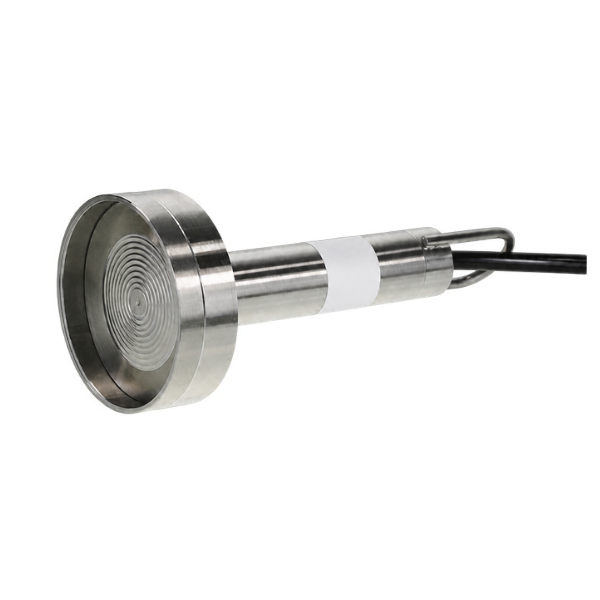
A rugged probe for liquids containing impurities and suspended solids. Nominal range 0…1 mH₂O to 0…250 mH₂O, accuracy ±0.35 % of span, IP68 and a medium temperature range of −40 °C to +125 °C. The enlarged 316L stainless steel separator reduces sediment clogging. Cable options include PVC, PUR, FEP and TPE-U.
LMK 351 Screw-in Level Transmitter
Ranges from 0–40 mbar to 0–20 bar with a flush-mounted ceramic sensor. A PVDF pressure port suits aggressive media, and a G 1 1/2″ thread option suits pasty or polluted media. Available as 2-wire 4–20 mA or 3-wire, with an Ex ia intrinsically safe version.
DCL 531 Stainless Steel Probe with RS485 Modbus RTU
A digital probe with RS485 Modbus RTU output, accuracy of ≤±0.25 % FSO and IP68 protection on a 26.5 mm stainless steel body. Level ranges from 1 to 250 mH₂O make it a fit where the station controller or RTU reads level over Modbus.
Certifications & Compliance
Approvals and protection ratings vary by model and version, so confirm the options you need on the relevant product page or with our team. The products above offer the following:
Ex ia intrinsic safety — optional on the LMK 358, LMK 358 H, LMK 382 H, LMK 387 H and LMK 351 for wet wells with a potentially explosive atmosphere
HART® communication — LMK 358 H, LMK 382 H and LMK 387 H (revision 7) for remote configuration and diagnostics
IP68 ingress protection — LMK 387 H, CPA-325S and DCL 531 for continuous submersion
EN 61000-4-5 surge protection — integrated on the LMK 808 for exposed outstation locations
DVGW and KTW drinking water certificates — available on the LMK 387 H and DCL 531