

Level Sensors for Early Flood Warning Systems
A flood warning is only as good as the level data behind it. Environmental agencies and hydrometric networks rely on river gauging stations, catchment outstations and coastal tide gauges to report stage continuously, so that forecasters can see a rise developing and issue alerts while communities still have time to act. Those stations often run unattended for months on exposed riverbanks, bridge piers and harbour walls, and they have to keep measuring through spate flows, silt, storms and long periods on battery and solar power.
Stork Solutions supplies level instrumentation for flood forecasting and warning networks, from SDI-12 rotary encoders for float-operated stilling wells and tide gauges to 316 stainless steel submersible level sensors with SDI-12 or analogue outputs. Barometric sensing, vented junction boxes, configuration tools and cellular telemetry complete the outstation, alongside our wider range for environmental monitoring and meteorology.
Product Spotlight for Early Flood Warning Systems




Why Early Flood Warning Systems Matter
Flood warning depends on spotting a rise early, trusting that it is real and passing it on quickly. A well-specified level monitoring station helps network operators to:
Detect rising stage early — frequent, accurate readings show the rate of rise as well as the level itself, giving forecasters more lead time before a threshold is reached
Act on alarm thresholds — telemetry that compares each reading with alert and warning levels can notify duty officers as soon as a threshold is crossed or a station stops reporting
Follow tides and surges — coastal and estuary gauges record every tidal cycle, so a surge or unusually high water stands out against the expected pattern
Run unattended for long periods — low-power SDI-12 sensors keep the load on battery and solar supplies small at remote outstations
Build a dependable record — consistent stage data supports rating curves, model calibration and post-event review long after the flood has passed
Level Sensors for Every Flood Warning Application
Rotary Encoders for Stilling Wells and Tide Gauges
Float-operated stilling wells remain a standard arrangement at river gauging stations and tide gauges. The well damps waves and surface turbulence, while a float and counterweight on a pulley turn the encoder shaft as the water rises and falls, giving a direct mechanical link to stage that is easy to check against a staff gauge.
E24R-155 SDI-12 Digital Rotary Encoder Level Sensor
Accuracy of 0.01% of full scale (for example, 1 mm over a 10 m range) with an SDI-12 Version 1.4 output. A float or pulley mechanism drives the 8 mm steel shaft, and the lightweight anodised aluminium body offers rotation speeds up to 10,000 rpm, low power consumption and internal battery backup. A 2 m screened PVC cable is standard, with alternative lengths available. Listed applications include tidal monitoring and river, reservoir, canal and stream levels.
E24R-150 SDI-12 Digital Rotary Encoder
An SDI-12 rotary encoder with embedded electronics and a microprocessor, giving a high-resolution, repeatable output with low power consumption and internal battery backup. The 8 mm steel shaft fits many types of pulley and the body is lightweight anodised aluminium. Listed applications include tidal monitoring, reservoir, river, canal and stream monitoring, and hydrological research.
Submersible Level Sensors for Open Channels and Flood Storage
Where there is no stilling well, or a new gauge has to be added quickly on a flashy upland stream, a submersible pressure sensor fixed in protective ducting measures hydrostatic head directly. The same approach suits flood storage areas and retention basins, where operators need to know how much capacity remains before water passes downstream.
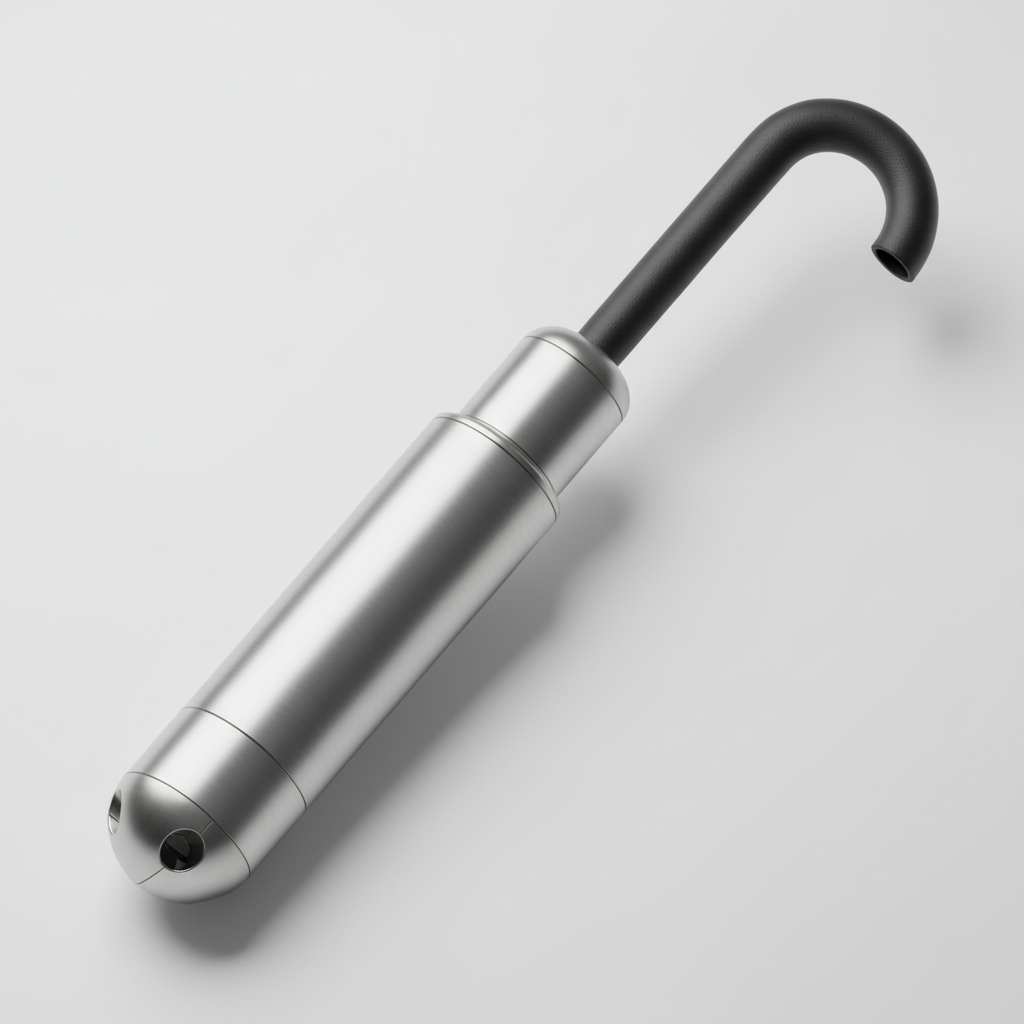
SLS-SD Submersible Level Sensor (Digital Output)
Level ranges from 0.5 mWG up to 100 mWG with an SDI-12 Version 1.4 output and level and temperature as standard. Power consumption is less than 250 µA when idle and less than 4 mA when active, and up to 9 devices can share a single bus. Construction is 316 stainless steel with a PUR submersible cable and IP68 protection for submersion up to 100 m. Listed applications include rivers, reservoirs, boreholes and flood defence monitoring.
SLS-SA Submersible Level Sensor (Analogue Output)
The analogue version for loggers and telemetry with current or voltage inputs. Level ranges from 0.5 mWG up to 100 mWG, with accuracy options of <±0.25%, <±0.15% and <±0.1% and outputs of 4…20 mA (2-wire), 0…5 V or 0…10 V (3-wire), 0.5…4.5 V ratiometric (3-wire) or a low-power millivolt signal. A temperature output is optional, and the 316 stainless steel body with PUR cable is IP68 rated for submersion up to 100 m.
LMK 307 T Level and Temperature Transmitter
Pressure ranges from 0…4 mH₂O up to 0…250 mH₂O and temperature ranges from 0…30 °C up to 0…70 °C, with separate 2-wire 4…20 mA outputs for level and temperature. A flush ceramic sensor in a 26.5 mm stainless steel housing gives long-term stability, and listed water applications include groundwater monitoring and rain spillway basins.
Barometric Reference, Venting and Sensor Configuration
A hydrostatic sensor responds to the total pressure above it, so atmospheric pressure has to be accounted for, either through a vented cable or a separate barometric reading at the station. Discuss the right compensation approach for your sensors with Stork. Field teams also need a simple way to zero, configure and check SDI-12 sensors during commissioning and routine visits.
SBPT Barometric Pressure & Temperature Transmitter
A low-power transmitter with a piezo-resistive silicon sensor and an NTC 10 kΩ thermistor for atmospheric pressure and air temperature. Its product parameters list a 750…1250 mbar range (others on request), an SDI-12 V1.4 output, pressure accuracy of ≤±0.25% FSBFSL and temperature accuracy of ≤±0.2 °C, with a 2 m screened cable outlet or M12 connector and a die-cast aluminium housing. Confirm the range, output and outdoor installation details with Stork.
XSYS-0013 Vented Junction Box
Joins sensor cables and lets submersible sensors breathe to atmosphere, with the vent tube terminated inside the box to prevent moisture build-up. Designed for outdoor use, it is made from ABS with an IP67 rating, 2 x PG9 cable glands, AKZ-4 DIN rail terminals and a fast-closing lid.
USB-SDI12-PRO USB Powered SDI-12 Interface
Connects SDI-12 sensors to a laptop and powers them from the USB port for use with the Stork DCT (Device Configuration Tool). Technicians can zero sensors, set level and temperature units, adjust filter settings and sample rates, use a calibration mode for annual calibrations and log up to 10 sensors at once.
Telemetry, Data Logging and Alarm Thresholds
A level reading only becomes a warning when it reaches the people who act on it. Telemetry outstations send stage readings on a regular schedule, compare them with alert levels and raise an alarm when a threshold is crossed or a station falls silent. Analogue sensors such as the SLS-SA and LMK 307 T connect to the 4…20 mA inputs below; for SDI-12 networks, discuss logger and telemetry integration with Stork.
ECHO4 Remote Monitoring System
Four analogue inputs for 4…20 mA and 0…10 V sensors, with pulse and RS232/RS485 expansion cards available. Readings are sent over cellular with a multi-network SIM to the ECHOVIEW cloud platform, with subscription plans for transmission every 60, 10 or 5 minutes. Email alarms are sent when thresholds are breached or a device stops communicating, and thresholds can be set remotely. Two relay outputs and an IP67 self-contained enclosure complete the unit.
ECHO-IoT Remote Monitoring Gateway
Four 4…20 mA or 0…10 V analogue inputs, eight volt-free digital inputs, four relay contacts and Modbus RTU/TCP/IP over RS-232, RS-485 or Ethernet, with a built-in 2G/3G or 4G modem and MQTT. It sends email or SMS alarm messages, gives access to logged data through a web-based SCADA interface and supports up to 128 IWT wireless transmitters. Supply is 12…36 Vdc and the gateway is IP67 rated.
Certifications & Compliance
Approvals and protection ratings vary by model and version, so confirm the options you need on the relevant product page or with our team. The products above offer the following:
IP68 ingress protection — SLS-SD and SLS-SA, rated for full submersion up to 100 m depth
IP67 ingress protection — ECHO4, ECHO-IoT and the XSYS-0013 vented junction box
SDI-12 Version 1.4 — E24R-155 and SLS-SD, with the SLS-SD stated as fully verified and compliant